Loading card catalog…
No cards match
Try a different search, or loosen your filters.
Learn
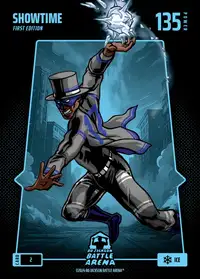
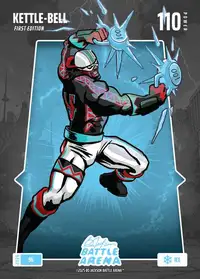
Goal
Best-of-7 Battles. Higher Power wins each Battle. First player to win 4 Battles wins the game. A game can end as early as Battle 4 (4–0 sweep).
Setup
- Each player shuffles their 60-card Hero Deck and places it face-down.
- Each player places 7 Heroes face-down in a row — these are the 7 Battle Slots.
- Each player rolls one die. High roll wins initial Honors — the right to act first each battle. Re-roll on a tie.
Each Battle
- Both players simultaneously flip their Hero face-up.
- The player with the higher Power wins the battle and takes the point.
- Tied battle: If both Heroes have equal Power, the battle is a draw — no trophy is awarded. Honors stays with the same player.
- Tied game → Sudden Death: If both players win the same number of battles after all 7, each reveals the top card of their Hero Deck. Higher Power wins. Repeat until broken.
- Honors passes to the winner of each battle. On a draw, Honors stays the same.
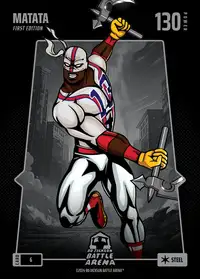
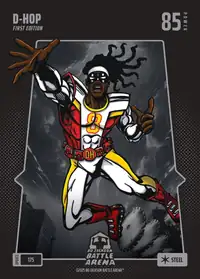
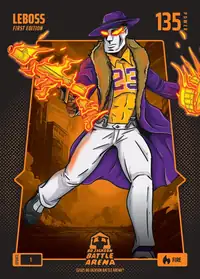
Additional Setup
- After placing your 7 face-down Heroes, draw 4 additional Heroes from your Hero Deck and place them in your Bench (kept hidden from opponent).
- Draw all 10 Hot Dogs into your Hot Dog pile. The count is always public information.
Substitution Phase
- Before Heroes are revealed — cards are still face-down. This is a blind decision.
- Cost: 2 Hot Dogs — send the face-down Hero to the Discard Pile. Place a Hero from your Bench face-down into the Battle Zone. Draw a new Hero from your Hero Deck to refill your Bench.
- The Honors player decides first. The opponent then decides. Each player may substitute at most once per battle.
Honors & Information
Honors moves to the battle winner. Having Honors means you substitute first — your opponent sees whether you substituted before making their own decision. Sometimes it is strategically better to pass, forcing your opponent to commit first.
Resource Note
You only have 10 Hot Dogs for the entire game. At 2 per substitution, that's a maximum of 5. Save them for battles where the power gap is meaningful.
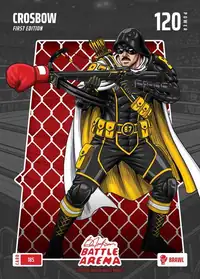
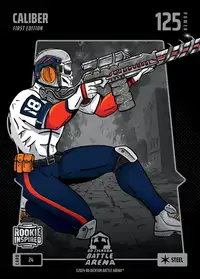
Additional Setup
- Shuffle your Playbook. Draw 4 Plays as your starting hand.
- Draw 1 Play at the end of each battle (during cleanup).
Play Window
- After Heroes are revealed, the player with Honors may run one or more Plays, then passes.
- The other player may then run one or more Plays, then passes.
- Pay the Hot Dog cost shown on the card and resolve its effect.
- Each player gets only one opportunity per battle to run Plays. Once you pass, you cannot play more cards that battle.
Super Weapon Tiebreaker
In Playmaker mode only — if a battle ends in a tie and one Hero has the Super weapon type, that Hero wins automatically. No Sudden Death needed.
Tournament Formats
- Standard Playmaker — the competitive and tournament-standard format.
- SPEC Format — No single Hero may have Power above 160. Sideboard of up to 45 standard Plays + unlimited Bonus Plays. Players may swap Plays between matches, but NOT between games within a match.
Deckbuilding
| Deck | Size | Rules |
|---|---|---|
| Hero Deck | Exactly 60 | Max 6 copies of any single Power value; only 1 copy per variation; up to 6 of same Hero across all variations |
| Hot Dog Deck | Exactly 10 | Duplicates allowed |
| Playbook | Exactly 30 | All Plays must have unique names; Bonus Plays may be added beyond 30 |
| Limited Format | Minimum 40 Heroes | For Draft/Sealed events only |
Card Zones
- Hero DeckYour 60-card draw pile
- Battle Slots7 face-down slots placed at game start
- Bench / HandPrivate — 4 Heroes drawn for substitution and Play cards drawn from Playbook
- Active BattleThe Hero currently in the active battle
- Discard PilePublic — defeated and substituted Heroes
- PlaybookYour 30-card Play deck
- Hot Dog PileCount is always public information
- Hot Dog DiscardSpent Hot Dogs
- AbyssRemoved permanently — cannot be retrieved
Hero States
- BenchFace-down Heroes waiting for their Battle
- ActiveThe Hero currently in a Battle
- RetiredHeroes who lost; out for the match
- PlayedFace-up Plays applied to the active Hero
- UsedFace-down spent Plays
Edge Cases
- Substitution cost is always 2. Cost-modifier plays (e.g., Dog On Inflation, +2 to plays) do not affect Substitution. Substitution always costs 2 Hot Dogs regardless of active modifiers.
- Pull The Plug only cancels rest-of-game effects. Persistent effects scoped to specific battles (next 2 battles, battle 7, etc.) survive Pull The Plug. Only effects that would otherwise apply for the rest of the game are cancelled.
- Recycle clears attached effects. When a Play is shuffled out of your discard back into your Playbook, any rest-of-game effect it had stops applying. Recycling Flash Sale removes its −1 cost discount on future plays.
- Play Booster recounts every time. Play Booster's draw amount equals the number of plays used this battle, including itself. Played twice in the same battle? The second recount includes the first Play Booster.
- Deck exhaustion auto-reshuffles. If your Playbook runs out, shuffle the discard pile back into the Playbook and continue. The same applies to the Hero Deck during Sudden Death — shuffle the Discard back if needed.
- Bonus Plays don't count against the 30-card limit. Bonus Plays (gold-treatment cards) are extras — they enter through element-trigger effects mid-game and don't count against the 30-Play deckbuilding cap.
- Tied battle keeps Honors. If both Heroes have equal Power and no Super-weapon tiebreaker applies, the battle is a draw. No trophy is awarded; Honors stays with the same player who had it going in.
Understanding DBS (Deck Balancing System)
DBS is a per-Play cost system used in Nationals-style formats to keep individually powerful Plays from crowding out the rest of a deck. Every Play has a DBS score; your deck's total must stay under the format's cap (1,000 for all Playmaker divisions at 2026 Nationals).
- Every Play card has a DBS value (Low 1–20 / Medium 21–40 / High 41–60 / Very High 67+).
- Your 30 Plays sum to a total DBS; the deck builder shows it live.
- Stay ≤ deck's budget (typically 1,000) — over-cap decks fail legality check.
- Non-Nationals formats (Rookie, Substitution, Playmaker base) ignore DBS entirely.
- Bonus Plays count toward DBS in formats that include both.
- High-DBS Plays are powerful but force you to fill the rest of the deck with low-DBS Plays.
Tip: tap the purple DBS chip on any Play card to see how
adding it changes your active deck's total.
April 2026 update: BoBA rebalanced DBS values to restore meaningful decisions. Low-cost Plays (especially 0- and 1-cost effects) now carry higher DBS than before; key cards that enabled full-deck cycling or repeat loops were rebalanced. Draw, recovery, and manipulation effects are still powerful — they just come with a real cost now. See the BoBA team's announcement.
Power Curve Management Spread your deck across power bands; position slots strategically
The 6-per-power-value rule forces you to spread across multiple power levels. Build with intention:
- High-power Heroes (160–200) — for critical battles you cannot afford to lose
- Mid-range (120–155) — consistency and volume
- Lower-power Heroes (85–115) — inevitable, but position them wisely
Place battle slots strategically — front-load to establish Honors momentum, or back-load to close games. Battle 7 is do-or-die; consider saving a strong Hero. Plays like Late Hit (+35 in Battle 7) and The Closer (+40 in Battle 7) reward this approach.
Weapon Synergy Build around 1–2 weapon types; many Plays reward consistency
Many Plays reward weapon-type consistency. Build around 1–2 primary weapon types:
Substitution Strategy 10 Hot Dogs total — spend them where it counts
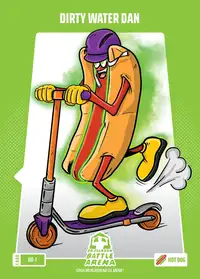
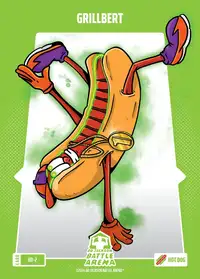
You only have 10 Hot Dogs for the entire game — shared between substitutions (2 each) and Play cards. Don't substitute reflexively.
- Substitute only when the power gap justifies the cost
- Watch your opponent's Hot Dog count — at 0 they cannot substitute or play paid cards
- Save substitutions for battles 5–7, which are often the most decisive
- Having Honors means you substitute first; sometimes it's better to pass and respond after seeing their choice
Play Card Types Tempo · Value · Disruption · Economy · Game-changer
Resource Management Plays and Hot Dogs are finite — track both carefully
You start with 4 Plays in hand and draw 1 at the end of each battle (up to 11 total across a full game).
- Hot Dogs fuel both substitutions and Plays — don't exhaust them on early battles
- Free (0-cost) Plays are disproportionately valuable; they preserve Hot Dogs while adding power
- Track the opponent's Hot Dog count openly — at 0, they cannot act in the Sub or Play window
- Always count your opponent's remaining Plays: they start at 30, and spent Plays are visible
Starter Decks
Five meta-informed decks you can load straight into the deck builder. Each is legal under every rule set (Apex, Spec, Spec+, Elite) and respects the per-power 6-copy cap. Pick a starting point, then build your own from there.
Steel-anchored disruption; close mid-game with high-DBS lockouts.
60 STEEL Heroes (85–160 power) build hot-dog economy early, then pivot to Steel-stacked battles where lockout Plays end the round before your opponent can swing back. Teaches when to hold lockouts for late-battle swings rather than burning them on a bad matchup.
Ice synergy + substitution control + economy denial.
60 ICE Heroes (75–160 power) anchor a substitution-heavy game plan. Forced Substitution and Blind Substitution flip matchups; Icy Shield prevents your Heroes from being subbed out. Teaches Substitution as a strategic axis, not just a panic button.
Engine-first deck; maximum draw and situational answers.
12 Heroes each across FIRE / ICE / STEEL / GLOW / HEX gives you an answer for any matchup. The Plays package leans on draw, recovery, and lineup pressure rather than weapon synergy. Teaches how draw advantage compounds across 7 battles — every extra Play you see is leverage.
Discard-as-fuel + GLOW synergy + bonus-play toolbox.
60 GLOW Heroes (95–160 power) feed a discard engine that turns spent Plays into power. Flip & Glow and Glowaway recycle resources; Lost Plays punishes opponents who hoard. Built around the SPEC format constraints (≤160 power) where every discard counts as a tempo move.
Aggro tempo. BRAWL/FIRE mix; win the first 3–4 battles.
30 BRAWL + 30 FIRE Heroes (80–160 power) front-load the curve. Add Firepower, Burn To Burn, and Banked Power push damage early; Flame Wall protects your tempo lead. Teaches tempo-aggro counter-strategy — you don't need to win all 7 battles, just the first four.
FEATURED COLLECTIONS
The man who inspired it all — every BoJax card across every set and treatment.
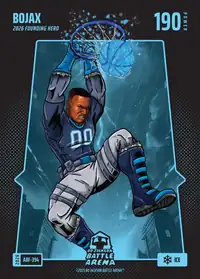
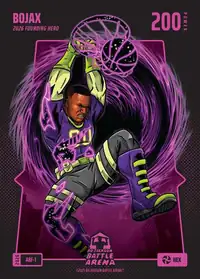
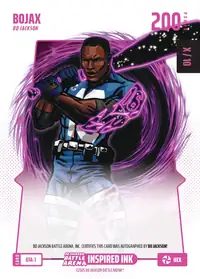
Women of BOBA — heroes inspired by 17 legendary female athletes across every sport.
The Kid — one of baseball's most beloved players, hero name: The Kid.
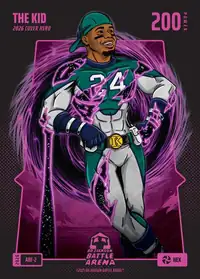
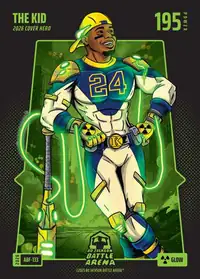
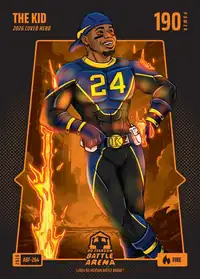
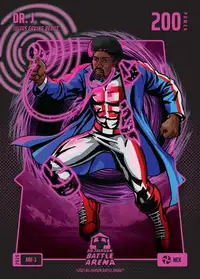
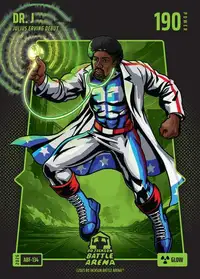
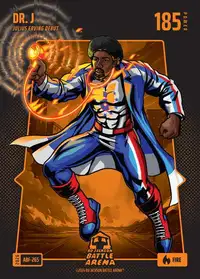
Julius Erving — the original aerial artist of basketball.
BY WEAPON TYPE
BY SPORT
Tap a hero to browse their cards in Search.
RARITY BY WEAPON TYPE
In BOBA, a hero's rarity is tied to its weapon type. From most common to most rare:
Brawl, Super, Alt, and Cyber sit outside this six-weapon spectrum — Super especially is tie-breaker-only and typically appears serialized.
TREATMENTS
Treatments are the different ways a given card can be printed — Base Set, the Battlefoil family, themed foils, and the premium Inspired Ink / Superfoil chase tiers. The prefix on the card number maps to its treatment.
Inspired Ink cards carry hand-stamped serial numbers — typically /5, /10, /25, or /50. The exact print run is stamped on the card art itself; it varies by individual card, not by weapon type. Open a card's detail view to see its actual print run (we OCR it off the art for the 464 numbered cards in the catalog).
STANDARD
THEMED
PREMIUM
PARALLELS
Parallels are separate card runs that share the BoBA format but aren't print variants of the base set. They have their own numbering and collectibility profile.
VARIATIONS
Variations mark distinct print runs. The same hero in the same treatment can exist across multiple variations — each is separately collectible with its own scarcity and market value.
- The original print run — the baseline for all sets
- Most widely available; the first cards released for every hero
- All treatments from Base Set through chase exist in First Edition
- Look for the First Edition stamp on the card face to confirm
- Second print run of select Alpha and Griffey Edition cards
- Introduces three exclusive treatments not available in First Edition: Logofoil, Colosseum Battlefoil, and Great Grandma's Linoleum Battlefoil
- Typically harder to find than equivalent First Edition cards
- Often features revised or updated card art
- Each hero's official introduction card into the BOBA universe
- Only 70 printed per hero — meaningful scarcity even for common heroes
- Many Debut cards carry serial numbers, making individual copies uniquely identifiable
- The definitive collector piece for fans of any specific hero or athlete
- Reveals the real-world athlete behind the hero mask
- Features athlete-focused art rather than the hero persona
- Only 70 printed per hero — as scarce as Debut variations
- Typically commands the highest value of any variation for a given hero
- The premier card for collectors building athlete-specific portfolios
SET ASCENSION — HOW FORMATS EVOLVE
BoBA organizes play across three formats based on when cards released. Older sets don't fade — they ascend into legacy formats with their own competitive scene. "Time adds context and fond memories" so cards take on new identity over time.
- Cards from the past 2 years
- Primary competitive format
- Best entry point for new players — where most gameplay happens
- Cards released 2+ years ago (as of January 1)
- Larger card library with complex interactions
- Reserved for special, high-skill events — emphasizes mastery over volume
- Exclusively original Alpha-era cards (first year)
- Celebrated annually with dedicated events
- Alpha cards also playable in Hall of Fame — preserves BoBA's foundation
Alpha Battlefoils bridge the eras. A special card type that lets newer players participate in Hall of Fame and AlphaTrilogy events without owning original Alpha cards. Connects the modern audience to the game's foundation.
Press and hold any term (right-click on desktop) to copy or share its definition.
GAME GLOSSARY
Terms you'll hear in rules discussions, deck building, and battle flow.
TRADING GLOSSARY
Community shorthand used in the Discord trade room, Whatnot streams, and eBay listings.
UPCOMING EVENTS
No events scheduled yet. Check back as the BoBA team announces dates.
RECENT BOBA NEWS
Loading…
2026 PRO-TOUR
The 2026 World Championships at The National offers an estimated $500,000+ in total prizing, with up to $375,000+ available as cash payouts. APEX events are free to enter.
As a Coach, you lead a squad of superheroes into battle. The Heroes bring the power; you bring the strategy. You decide the roster, call the Plays, and pick when to push or hold. Assistant Coaches are allowed in all events unless otherwise specified — a pairing to increase accessibility for younger Coaches or those with special needs.
TOURNAMENT FORMATS
| Format | Description | Notes |
|---|---|---|
| Rookie | Hero Deck only. Pure power comparison. | New player friendly |
| Substitution | Hero Deck + Hot Dog Deck. Add hand management. | Intermediate |
| Playmaker | Full game — Hero + Hot Dogs + Playbook. | Tournament standard |
| SPEC | Playmaker variant: no Hero above 160 Power. | Sideboard of 45+ Plays |
| SPEC+ | SPEC + up to 10 overflow Heroes 165–200 Power (tiered limits). | Per-power-tier caps |
| Elite | Playmaker variant: total deck power ≤ 8,250. | Combined Power cap |
| Sealed | Open a booster box. 40-card Hero Deck, 20 Plays. | Limited format |
| Checklist | Deck-building restricted to a curated Play list. | Event-specific themed pool |
CHECKLIST FORMAT
Build decks from a curated list of Plays — a Checklist. Each Checklist creates its own gameplay environment with themed restrictions: high-offense, control, chaos, weapon-focused, etc. Core BoBA mechanics stay identical; only the available card library changes.
- Limited card library — only Plays from the active Checklist are legal
- Theme-driven gameplay (offense / control / chaos / weapon-focused)
- Rotating or event-specific Checklists ensure variety
- Some overlooked Plays suddenly become stars within their environment
- Players answer "how do I win in this environment?" rather than "what's optimal?"
When Checklist fires. Event-specific. Each tournament publishes its active Checklist with the event listing. The Checklist column in the per-card format-legality chip shows green when a card is generally legal under Checklist rules, but the actual event Checklist may exclude it — always check the event's announced Checklist.
DOUBLE-UP (OPTIONAL ADD-ON)
Simple Press-and-Fold wagering layered onto any game mode. Adds the depth of a backgammon doubling cube to BoBA.
- Each Game of 7 Battles starts worth 1 point. First Coach to 7 points wins the match-up.
- Each Coach gets one Press per Game — called after hands are dealt, or between Battles.
- Opponent responds: Accept the Press, Press back (if they haven't used theirs), or Fold and end the game.
- No Double-Up game ends in a tie — ties resolve by Top Deck (each Coach reveals the top of their Hero Deck until one wins).
- Between-battles Press-and-Fold is called the "Laundry Phase."
MADNESS (TEAM PLAY)
4-Coach team formats. Each Coach brings 4 of their favorite Foil Hot Dogs to display as team mascots at every match.
| Variant | Rules |
|---|---|
| Apex & AlphaTrilogy Madness | Head Coach runs a full Apex deck; teammates play Spec 160 decks that can unlock Apex cards by including 10-of-an-insert or 4 Foil Hot Dogs. Max-optimized teammate decks reach 70 Heroes with 6 Apex cards. |
| HiLo Madness | Team format where Head Coaches play "High Ball" (highest Power wins) while teammates play "Low Ball" (lowest Power wins). Used in Granny's Gum, Brawl, and Tecmo Bowl divisions. |
2026 NATIONALS DIVISIONS
| Division | Prize Pool |
|---|---|
| Apex | $150,000 · free to enter |
| AlphaTrilogy | $100,000 |
| Tecmo Bowl | $50,000 |
| Open | up to $40,000 |
| Blast | $20,000 |
| Brawl | $20,000 |
| Granny's Gum | $20,000 |
| Power Glove | $15,000 |
Prize totals approximate — see the official rules PDF for the current published version. Mono-insert Hero Decks in the Open division may double their cash prize.
MATCH STRUCTURE
| Level | Structure | Notes |
|---|---|---|
| Game | Best-of-7 Battles. First to 4 wins. | 3–3 after 7 → Sudden Death on final battle |
| Match | Generally one game per match. | TO may announce a different number |
| Timed Rounds | Current turn + one additional turn. | No winner after extra turn → draw |
| Elimination Tiebreaker | 1) Most games → 2) Most battles → 3) Top Hero Deck card | Repeat Step 3 until broken |
Deck Registration — Decklists are mandatory for all tournaments. Register your exact 60/10/30 lists before Round 1.
PENALTY REFERENCE
5 penalty levels — Caution through Disqualification
DECK BUILDER
Deck Rules
Hero deck format flows through to deck construction. Other knobs persist for now — additional engine wiring lands in upcoming releases.
Rotate to landscape
Practice battles are built for a wide screen. Turn your phone sideways to fit the whole playmat.
Live Breaks
Live community streams featuring Bo Jackson Battle Arena.
@username
Loading…
This collection isn't public.
If you own this profile, enable Public Collection in your Profile sheet.
Start your own BOBA collection
Track your cards, build decks, share your collection — free, mobile-first, no installs needed.